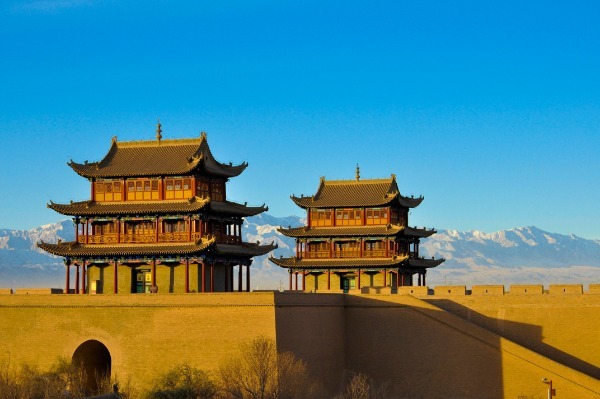
Jiayu Pass
Introduction
Jiayu Pass, known as "China's No. 1 Pass," is one of the most significant historical and architectural landmarks in China, situated in the middle of the narrowest valley, approximately five kilometers west of Jiayuguan city in Gansu province. It serves as the westernmost gateway of the Ming Dynasty Great Wall and is often referred to as the "throat of the Hexi Corridor" due to its strategic importance. The pass, along with Shanhai Pass and Zhenbei Terrace, is often considered one of the Three Wonders of the Chinese Great Walls.
Historical Significance and Construction
Construction of Jiayu Pass began in 1372 during the fifth year of the Hongwu Period in the Ming Dynasty. It was strategically built to control and guard against invasions and to serve as a critical military outpost. The pass consists of a series of fortifications, including the inner city, outer city, enclosure city, urn city, moats, and the northern and southern wings, stretching approximately 60 kilometers in total. It is a world cultural heritage site and serves as a national patriotic education base.
Architectural Features
Jiayu Pass is constructed in a ladder-shaped layout, with a perimeter of 1,107 meters, covering an area of 84,554 square meters. The inner city, the main part of the pass, features a distinct narrowing shape from bottom to top. The city walls, nine meters high, are reinforced with buttress and parapet walls. The structure includes two main gates: "Guanghua Gate" in the east and "Rouyuan Gate" in the west, each adorned with three-storey towers. Brick corner towers and watchtowers enhance its defense capabilities.
The pass also includes urn cities outside each main gate, named "Chao Zong" and "Hui Ji," opening to the south. The enclosure city features an arched door, leading to the pass city, and is built with grey-green bricks. Fortifications made of sands and gravels form a crescent shape outside the pass, serving as the first line of defense.
Role in the Silk Road
Jiayu Pass played a crucial role as a transportation hub on the ancient Silk Road, facilitating trade exchanges between China and foreign states. Its location and robust military defense system made it the most important military port along the Ming Dynasty Great Wall in western China. The pass's preservation contributes to the historical legacy of the Silk Road, reflecting the cultural and economic exchanges that occurred along this ancient trade route.
Associated Structures
The Xuanbi Great Wall, also known as the Overhanging Great Wall, is an important part of the western Great Wall of Jiayu Pass, built in 1540. The Rouyuan Gate symbolizes the Ming Dynasty's policy of conciliation towards nomadic tribes, promoting long-term peace. The Wenchang Pavilion, a two-story structure, served as a meeting place for intellectuals during the Ming and Qing Dynasties.
Preservation and Cultural Impact
Jiayu Pass is a key cultural relic under national protection and a popular tourist attraction. Its historical significance and architectural grandeur have made it a symbol of China's rich cultural heritage. The pass's strategic importance and role in fostering trade and cultural exchanges along the Silk Road continue to be a subject of interest for historians and tourists alike.








